Showing posts with label Tales of Terror. Show all posts

Wednesday, October 31, 2012

HALLOWEEN TOP 10: MOVIES IN THE SPIRIT OF THE SEASON

This year I've been a tad lazy and decided to just make two Halloween Top 10 list. All work and no play has diminished my time to actually sit down and dig through the range of new favorite characters, inventive costumes or debuting  filmmakers. So I've narrowed it down to two lists; my favorite Halloween jingles and the following - a list of the ten movies which I feel best embody the spirit of Halloween. 

10. Creepshow (1982)
This collaboration between director George A. Romero and author Stephen King brings five tales of terror to the screen, inspired by the E.C Comics of the 1950's (which were also the basis for the popular Tales From the Crypt TV series). The five stories are framed within the pages of a comic book which a young boy's insensitive father has thrown in the garbage, and are linked to each other with animated bridges in the style of the old comics. Romero and King have effectively approached this movie with a combination of thrills and gimmickal humor.


9. Pumpkinhead (1988)
A Ten Little Indians story set in Deliverance outbacks, Pumpkinhead presents a season inspired Boogeyman, conjured by a man whose son is accidentally killed by a group of teenagers who pass across their land. Despite the hollowness of the acting (at times) and the questionable props (mostly the costumes), this is a dark fairy tale that teaches us that vengeance isn't always the best course of action. At its heart this is a tale of morality that stands out from the 80's crowd of low budget horror movies. The design of the monster is a thrilling representation of something vaguely humanoid but at the same time completely alien and foreign.


8. Halloween (2007)
Rob Zombie's resurrection of John Carpenter's Halloween (1978) is one of my few favorites in the modern remake wave. It perfectly balances the brutal gore that can only be produced by Rob Zombie, and the tinkly chilling feel of 70's original. I know most Rob Zombie fans were disappointed after his landmarks House of 1000 Corpses (2003) and The Devil's Rejects (2005), and I can agree to the extent that the little boy who one day snapped and killed his sister for no apparent reason is far more scary than the Michael Myers background story that Zombie presents. However, I adore Rob Zombie's twisted touch, his perfect ear for accompanying butcher scenes with 70's country music and the way he avoided turning it into another high school slasher but instead made it a slaughterhouse stabathon.


7. Scream (1996)
As a half-parody, half-tribute to the "dead teenagers" movies of the 70's and 80's, Scream is the 90's answer to classic slashers which instantly became a success. Though the introduction and the ending are merely simple and bloody roughness, the complicated plot in between skillfully plays with the conventions of horror movies in a clever mix of irony, self-reference and blood spills. With constant references to its classic horror predecessors, Scream pays endless homage while at the same time subverting and adhering to the "rules" of horror films. This is truly the most entertaining fright fest of the 90's.


6. Halloween III: Season of the Witch (1982)
For the die hard fans of Michael Myers (myself included) it might be hard to accept the fact that he's not the villain of the third installment of the Halloween franchise. In fact he only appears briefly on a TV screen when the main characters watch a commercial for the first Halloween movie. As a sequel to Halloween and Halloween II this movie plainly sucks. On its on though, Halloween III: Season of the Witch is a perfect little midnight movie for the season, and once I got over the disappointment that Michael Myers has no place on this film, I started to notice the aspects of it that make it such an alluring movie on its own. The key element (which is also its link to the previous movies) is the mask. It holds a gateway to a greater evil that wishes to take the life away from children. As the children put their Halloween masks on they themselves become the boogeyman, the monsters and the ghouls. The trigger of the masks is the Halloween commercial from Silver Shamrock Novelties, which is an effective detail and has become a memorable aspect of the movie.


5. Trick 'r Treat (2007)
This delicious, gleeful anthology intertwines four different Halloween stories in a brilliant way, with each story complimenting the other. It holds a morbidly charming tone through out the movie and with its campfire-tale shivers and surprisingly fresh screenplay it never has a dull moment. With its thick autumnal atmosphere, jack-o-lanterns and bloody tricks, Trick 'r Treat is a full on homage to the Halloween season.


4. Fright Night (1985) 
Along with my top two choices, the original Fright Night has always been my must-see-every-season-movie. Perhaps not a classic, Fright Night still is a spook show of season spirit, wit, charm and the perfect amount of suburban creepiness. The story is simple and believable (if you're a horror-obsessed geek like Charley Brewster) and Chris Sarandon's suspiciously good looks is the perfect mask for the centuries of decay and seduction that this vampire neighbor has hidden in his closet.


3. The Exorcist (1973)
It really doesn't matter if you're a first time viewer or if you've re-watched this movie since you were too young to see it in the first place; there's no mistaking the gruesome tale and unnerving shocker that is The Exorcist. It's as disturbing today as it was 40 years ago. Few movies have managed to have the same mental impact on me (The Blair Witch Project, The Fourth Kind included) and the beautiful but brutal, yet simple, special effects contribute to the indescribable obscenities. Based on the last documented and known Catholic sanctioned exorcism in the US, The Exorcist displays a journey back in time where religion triumphs modern medicine and shakes the foundation of Christianity, which contributes to the movie's great historical value.


2. The Rocky Horror Picture Show (1975)
Although not a horror movie per se, this low-budget freak show offers an entertaining and bizarre cocktail of musical scores, weird costumes and outrageous characters. The Rocky Horror Picture Show came to be more of a social phenomena than a great picture of cinema. It turned social identification upside down with its fetish-based transsexual love musical. The Rocky Horror Picture Show is a cult classic and would best be experienced as a double feature at the drive-in midnight theaters. 


1. Halloween (1978)
Not only my favorite Halloween movie, John Carpenter's Halloween is my all time favorite horror movie. After all these years it remains untouched by the endless numbers of imitations and maniac-on-the-loose suspensers. Halloween is basically the original slasher movie; it came out of nowhere, was filmed in only 20 days and revitalized and patented the whole genre of slashers. With a stunning opening scene (seen from the child-monster's point of view) this suburban horror smash takes a scary stalkerish turn with its murder-incestious plot and twists into the bloody crescendos, which have made it one of the most influential movies ever.


Wednesday, January 4, 2012

THE FEMALE FASCINATION WITH FEAR: A PERSONAL JOURNEY THROUGH HORROR HISTORY'S BAD BOYS

Frankenstein postet
Relating to the latest releases in the horror/fantasy/paranormal/sci-fi genre that is blooming within the movie and television industry, it's easy to recognize the ongoing trend that is 'forbidden love'.

From one of the earliest science fiction infused with some elements of the Gothic novel as well as the Romantic movement, Mary Shelley's Frankenstein, first published in 1818, we have the author's vision of the "abhorred monster" being a version of the first man in Eden, as Mary Shelley herself referred to him as 'Adam'.

One of her greatest inspirations to creating Viktor Frankenstein and his 'modern experiments in the laboratory' was not only the electrical experiments on both dead and live animals conducted by Giovanni Aldini, but also the fragments of legends from the Balkan named Fragments of a Novel written by her friend Lord Byron, that later turned into John Polidori's The Vampyre (1819). Polidori transformed the vampire from a character of in old folklore into the form that it is has been recognized mainly ever since - an aristocratic fiend who prays among high society. And it is this vampire, his hunters and vile creatures alike, that has been remodeled to fit into the young girls' hearts, all the way into the 21st century.

"How I, then a young girl, came to think of, and to dilate upon, so very hideous an idea?"
- Mary Shelley

So what is it about these literal villains that rocks the female socks? For me it's a journey back to the the haunted aristocrats of my childhood, the two-faced knights in shining armor of my adolescence and the sexy sociopaths of my adulthood life.

Illustration of Heathcliff
Every since Mr. Darcy tore down the barrier of social classes in 1813, the brooding, the haunted and the lonely wolf characteristics became attracting. Still shunned by the aristocratic society but swooned by women nonetheless. In 1847 the outcasted and rebellious Heathcliff stole every woman's heart, followed by women's swooning over the thought-to-be-domestic-abuser Mr. Rochester, also in 1847, who continued the social criticism in the Victorian era with his moody and Byronic character.

Both Mr. Darcy and Heathcliff have jumped on the bandwagon and been 'monsterfied' and 'manlified' in the lastest wave of horror/sci-fi/fantasy/paranormal literature; the classical adaptions. The half man, half vampire Mr. Darcy fights his destiny of being born as a dhampir in Regina Jeffer's Vampire Darcy's Desire from 2009. Heathcliff fights of vampires out on the wuthering heights in Sarah Gray's Wuthering Bites, only to be revealed as a vampire himself.

Influenced by Emily Gerard's Transylvania Superstitions (1885), Bram Stoker took the 15th century Rumanian vojevod Vlad Ţepeş and turned him into the literal character that came to rock the role of women in Victorian culture and challenge the sexual conventions. Although not many adolescent women were, in 1897, taken by Count Dracula, the book became more significant to modern readers than it was to contemporary Victorian readers. The literal Dracula is on one hand described as his monster self; the beast like creature taken directly from Balkan folklore, and on the other as the charming aristocrat who easily attracts women. (This is what I call a real vampire!)

The post-colonial vampire who preys on higher society can be found in several characters in Anne Rice's The Vampire Chronicles; amongst them the 200 year old Louis de Pointe du Lac and the even older French nobleman Lestat de Lioncourt. Interview with the Vampire (1976) presents Louis telling his 200-year-long life story which has been filled with inner struggles between right and wrong, and the remorse that comes with following his primal instincts. The common theme between the bad boys who actually are attractive is their

Stefan Salvatore and Edward Cullen
The same struggles are found in Stefan Salvatore in The Vampire Diaries, written by L.J Smith, originally published in 1991. Stefan is the 500-year old male protagonist with an old soul aura but at the same time a fresh and youthful appearance. With an inner darkness that hides a rather violent past, Stefan is deeply angst and tortured by his vampirism and everything surrounding his dark, mysterious past, however, he has a strong hold on his humanity and strongly believes in justice, morals, values and doing the right thing. Anyone recognizing these traits in yet another modern vampire? Perhaps the sparkling Edward Cullen?

Basically ripping off the food consumption idea from The Vampire Diaries, Stephanie Meyer created a vegetarian vampire clan with the Cullen family in the Twilight series, first book published in 2005, re-planning their entire existence to fit into the world of humans and seeing them as their brother kin and not their prey. Totally boring? Yes.That's why I'm rooting for the viscous brother Damon Salvatore. Being scorned and betrayed by history's events in his literal self, Damon is much more arrogant and hateful towards his brother Stefan, having no attempts to be conciliatory with the latter. And how could you not love this anti-hero when he statues his love for Elena by draining Stefan half to death, telling him that Elena is his and that if Stefan ever comes between them again, Damon will kill him? Quite the romancer!

Alexander Skarsgård as Eric Northman
My favorite struggler in the modern world of socially adapted vampires, however, is the to totally charming character of Eric Northman in The Southern Vampire Mysteries/The Sookie Stackhouse Novels, portraited by the adorable Alexander Skarsgård in HBO's television series True Blood.

This ruthless vampire is the poster boy for bad attitude with no remorse. His 'joie de vivre' is culminated by his confidence and calculating mind, though he has a great capacity of not only loyalty, but affection, demonstrated with his progeny Pam. Eric's ruthless personalty is over-shown by his own conscience as he is faced with 'his true self' during the period in which he looses his memory and displays a soft side that would make any catholic school girl shiver under her plaid skirt.

The merciless killing definitely works for Jerry Dandridge - being aristocratic and wordly-looking like Chris Sarandon or simply sexy as hell as Colin Farrell totally floats my boat. Anytime. Showering with a complete sociopath is totally worth risking your life (and sanity) for if that psycho is named Patrick Bateman. And who could ever refuse the 'deer eye charm' from Tate Langdon, especially when he spices it up with with a rubber suit. Yummy!

Saturday, November 26, 2011

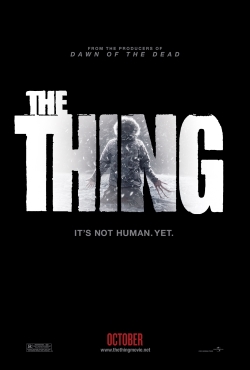
"IT'S NOT HUMAN. YET": 5 FUN TRIVIA ABOUT THE THING (2011)

Last night my boyfriend and I watched The Thing (2011) and I was fairly surprised how good the movie actually was. I'd suspected it to be too much of a remake even though it's produced as a prequel to 1982 John Carpenter's The Thing. There were a few scenes that were strikingly resembling sequences from the 1982 movie (like the human/alien group testing scene and the dog in the kennel, etc.), but for me these contributed more to the a prequel, although déjà vu, kind of feeling than being rip-offs. Most of all the 2011 movie is true to the basic premise; being absurdly sticky and icky.

Usually I'm not a fan of science fiction horror films but since I really liked the 1982 movie (much due to Kurt Russell's hotness!) I was positively surprised. I'm very thankful that they actually cast born and bred Norwegian actors. Usually Scandinavia is a misinterpreted term and a grey spot on the map for a lot of people, especially Americans. Some have a really hard time grasping the fact that Sweden, Norway and Denmark (here not counting Finland and Iceland) are three different countries with their own, but very similar, languages. The mistake of casting a Danish guy to play the role as a Swede (like Allan Hyde who plays Godric in True Blood; his Swedish is awful for the single reason that he's Danish!) is very common. In The Thing (2011) they've cast good, neutrally accented Norwegians and I was delighted to be able to understand all their comments and jokes (I don't know if there's a subtitled version?).

Apart from the computerized monster and digitialized effects (80's effects were so much better!) this is a really good movie where the ending scenes intertwine with the opening scene of the 1982 movie in a really smooth and effectual way.

5 FUN TRIVIA ABOUT THE THING (2011)

OBS! THIS POST MIGHT CONTAIN SPOILERS!


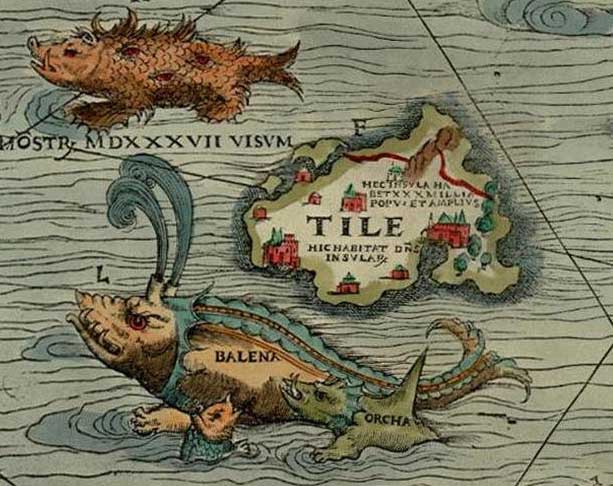
5. The research team's station is named Thule Station. Thule is mentioned widely in European literature and maps, as a region in the far north. The modern interpretation is that Thule could be identified as Norway, which would make it a fitting name for a Norwegian station in the Antarctic. The term "ultima Thule" in Medieval geographies refers to any distant place located beyond the "borders of the known world". Thule is also mentioned in the first stanza of Edgar Allan Poe's poem Dream-Land.

Thule map
4. I'm guessing most people who aren't from Scandinavia perhaps won't notice this, but the station's medical officer and leader of the research team, Dr. Sander Halvorson (played by Ulrich Thomsen), is Danish not Norwegian, and therefore speaks Danish with the team. This is not explained on neither IMDB nor Wikipedia, which I find really interesting.

Dr. Sander Halvorson, The Thing (2011)
3. I haven't read the 1938 science fiction novel Who Goes There? by John W. Campbell Jr., nor seen the 1951 movie adaption The Thing From Another World, which supposedly isn't an as faithful film adaption of the novel as John Carpenter's version from 1982. Apart from being adapted into three different movies, the story was adapted as a radio drama by BBC RADIO which was first broadcasted on 24/01/2002. The story was published in comic book form in issue 1 of Starstream, and Dark Horse Comics has released The Thing From Another World, a comic book in two parts that picks up the story where John Carpenter's movie left off.
The Thing From Another World (1951)
2. I read on IMDB that "in order to not try to compete with Kurt Russell's portrayal of the 1982 film's protagonist, R.J. MacReady, the character of Kate Lloyd was designed to have traits in common with the character Ellen Ripley from the Alien film series". This is really interesting as my boyfriend kept referring to scenes from the Alien film series through out the movie.

Alien (1979)
 1. My favorite detail was the song the crew's singing on the night that they've brought back "the thing" to their camp. At first I thought the song to be some kind of cultural joke from the American production company's side, since I recognize the melody from my childhood but always thought it to be a commercial jingle or likewise. It's not like Norwegians usually pick up a banjo and start yoiking every other second. But the melody is actually taken from "Sámiid Ædnan", the Norwegian entry in the 1980 Eurovision Song Contest, originally sung by Sverre Kjelsberg and Mattis Hætta. This song both contains lyrics in Norwegian as well as Sami yoik and the song title comes from a northern Norwegian Sami dialect. The song is a tribute to the Sami heritage and inspired by the Sami autonomy movement in northern Norway, and the lyrics are about the requirement of self-government.

Wednesday, October 5, 2011

WOMEN OF HORROR: I HEART GRETCHEN LOWELL!

I just wanna put my thumbs up for one of the best trilogies in the contemporary thriller genre; The Beauty Killer series by Chelsea Cain.

I stumbled upon the third book in the series as I was boarding a plane to Amsterdam almost exactly a year ago. I'd forgotten to bring something to read, and as I was glancing the shelves of the airport bookstore my eyes caught on Evil at Heart. Not only did it have a female serial killer for starters (yey!), it also took place in Portland, Oregon, spreading some gory human parts at the rest stops along the I-84. And as I was on this transfer flight to Amsterdam onwards to Portland, for the single reason of moving to a little town along the I-84, this seemed as the perfect reading material to get accustomed to the area.

While there's no escaping the gruesome and perverse murders, the focus of the series is mainly between the victim and the captor, in this case the twisted relationship between the female serial killer Gretchen Lowell and Archie Sheridan, the homicide detective that led the original investigation into her murders.

Gretchen Lowell is probably the most insane female entering the murder stage since the beautiful Charlize Theron portrayed Aileen Wournos in 2003's Monster. Except Gretchen Lowell is nothing like the Daytona Beach prostitute who became a serial killer; this is the most seductive psychopath since Dr. Hannibal Lecter.

After being chased for almost ten years by "the Beauty Killer Task Force", Gretchen volunteers as a psychologist to help Archie and his task force to find the killer. A relationship that evolves from flirtatious to horrid, as Gretchen captivates and starts torturing Archie. However, on the brink of his death, Gretchen suddenly saves his life and turns herself in. No explanation given.

Two years later Heartsick presents an Archie Sheridan, addicted to pain killers and still obsessed with Gretchen in a painful and perverse Stockholm Syndrome kind of way. Both Sweetheart and Evil at Heart are two compulsive follow ups with the perfect blend of organ-ripping and blood-soaked gore written with an engaging voice and with a narrative style. So yeah, go buy it!

Friday, August 19, 2011

WOMEN OF HORROR: MAMA'S GOT FANGS FEAT. PAM RAVENSCROFT & SOPHIE-ANNE LECLERQ

SPOILER ALERT! 

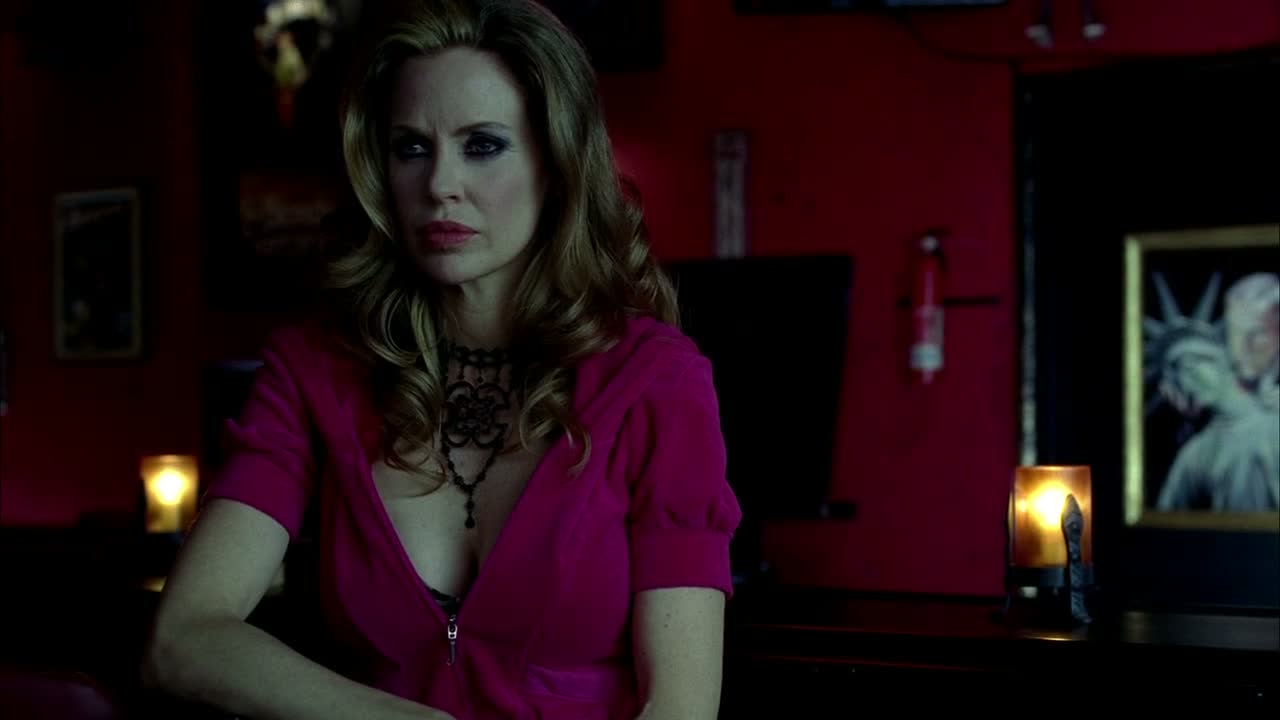
Pam Ravenscroft


Savvy, ruthless, cold-hearted, humorous and ravishing! Pam Ravenscroft is my absolute favorite vampire portrayed in The Southern Vampire Mysteries and True Blood. No one beats her sense of humor or her (lack of) fashion sense!
  
"I don't know what it is about me that makes people think I want to hear their problems. Maybe I smile too much. Maybe I wear too much pink. But please remember I can rip your throat out if I need to. And also know that I am not a hooker. That was a long, long time ago."
―Pam

1. Her humor
I just love her morbid sense of humor and the lethal charm to it. She seems to be the only main vampire character who's actually able to be subjected to humor. Eric's just too dumb to get the jokes, and Bill's too serious to even bother to offer a smile. Pam's bluntness and apathetic appearances are entertaining without her even trying. When she does try to joke (or threat); she does it with a lethal sarcasm that scares the shit out of most human. It's priceless.

"You fucking cunt, I'm gonna shove my fist up your ass and us you as a hand warmer!"
- Pam

2. Her dislike for humans (but sexual interest in them)
Pam's dislike for humans (and especially kids) makes her interactions with them so much more entertaining. Since she wasn't very attached to her own human life and willingly accepted the offer of immortality, it seems that she despises humans for the simple reason that she sees their lives as unnecessary and finally feels alive being a vampire (the same with Baby Vamp Jessica, thumbs up!).

Like most vampires she strongly believes her kind to be superior to their human counterparts and is somewhat apathetic to the concerns of humans. This makes her struggle to understand the intentions and feelings of Sookie (who's human) so entertaining and hilarious to follow. And though Pam has a hard time making friends with either race, or sex, she has no difficulties connecting sexually with either of them. More of that on True Blood, thank you!

3. Her (lack of) fashion sense
Who would have thought that vampires like dressing in pink plush!? Well, apparently they do. And no one can carry a pink plush suit with matching shoes and makeup better than Pam. In the beginning of The Southern Vampire Mysteries Pam reveals to Sookie that she hates putting on black leather, but she does it during her working hours at Fangtasia 'cause it's what the fang bangers anticipate and want. Otherwise it's the pink full-body suit that's on!

Even her coffin's quilted in pink with cream- and pastel-colored lace edges!


Sophie-Anne LeClerq
Louisiana queen Sophie-Anne LeClerq features in The Southern Vampire Mysteries series as well as the HBO show True Blood as the 500 year old vampire who still carries childish mannerisms and is probably suffering from some kind of attention disorder. This is just what makes her one of my favorites amongst Charlaine Harris' supes.

True Blood vs. The Southern Vampire Mysteries
What I love about the novels is that they first of all tell so much more on Sophie-Anne LeClerq than True Blood. In the show she was offed on the first episode of the fourth season, leaving the throne empty for none other than Vampire Bill. We all know that the Queen's been struggling with the IRS, being indebted for the years pre the Great Revelation and struggling to save as much of her wealth and property as possible. Whether it's by (tv-show style) illegally selling V and then finally resorting to marry the charming, but lethal, Mississippi King Russell Edgington, or by marrying the Arkansas King Peter Threadgill (novel style), we've come to known Sophie-Anne as a very powerful and survival instinctive young woman.


"Hell hath no fury like a vampire queen broke."
- Sophie-Anne

The difference between the two displays of this female vampire is that one of them takes the time to reach inside her character, and one only has the time to scratch the surface.
 
1. The personality disorder
It becomes very evident, in both the novels and the show, that Sophie-Anne suffers from some type of personality disorder. Which I just love. She is the typical example of a self-indulgent, attention seeking woman, used to having her ways. I love the way her instability and her contrasted mentality is described; her rambling, the abrupt changing of subjects, her hyper-focus on games and her impatience with uninteresting matters, and her lability which always seems to be on the verge of a breakdown. She reminds me of any 16 year old (human) girl, trying to balance on the thin line between her childhood and her womanhood.


"She's as mad as a monkey on a trike and she has been for centuries! "
Talbot on Sophie-Anne, the "Delightful Eccentric"

A trait of hers that is actually never fully displayed in True Blood. In Definitely Dead (#6 of the Southern Vampire Mysteries) we got acquainted with Sophie-Anne's (born Judith) abusive and tragic background, followed by the short story on how she was turned. This episode (both the historic memories but also the fact that Sophie-Anne sat down and took the time to even bother telling Sookie this) gave some depth to her otherwise rather stone cold appearances. Perhaps it's due to her early turning, but her attention disorder (which is not hard to guess where it's coming from when you know her story) and ADD personality never seemed to succumb to her new nature.

2. Regal and respectful
Queen Sophie-Anne possesses a very powerful and calculating mind. And although she's not as malicious and cunning as her state reigning neighbors, she still planned on how to use Sookie's gift (whether it's her fairie blood or her telepathy) to her greatest advantage. She only indulges in matters that further suit her own needs. Everything else is irrelevant. And that's probably what people tend to forget about her; that underneath that childlike, porcelain exterior is a selfish and ruthless being that should be treated accordingly.

3. The envy of humans
Although Sophie-Anne indulges in various entertainments and games with the human companions that she keeps at her mansion, her envy of the human race is never really portrayed in True Blood. With her mansion's day room with the green house, the pool and the light setting resembling daylight, it's evident that she has a longing for the outdoors and the sunlight. And the fact is that she might miss her own human life (or rather the opportunity of having a human life) so much that she values human life more than most other vampires presented. Her decision in keeping her consort Hadley human in the show might be, by most viewers, seen as a sign of dominance but it could also be seen as a sign that Sophie-Anne values the human life so much that she refuses to turn Hadley, despite that the choice means that she will lose her much sooner.

4. The maternal counterpart
The last thing you would call Sophie-Anne is maternal. As mentioned; she only does what suits her needs. But as ruthless as she might be, a 500 year old vampire would not stand a chance going up to some of the slightly older gentlemen. As a solution to this Sophie-Ann surrounds herself with a group of consorts, including her second in command Andre Paul, as well as the bodyguards Wybert and Siegbert. As we're learned in Definitely Dead these are her Children who she's able to keep with her and communicate with on a telepathic level. Though this doesn't make her into a biological or conventional mother, it still shows a maternal counterpart to this self-indulgent child, which unfortunately never had the chance to be displayed in True Blood.


Since Sophie-Anne LeClerq already has been eliminated from True Blood, I still hope for a last encounter in one of the coming books. I've only read the first eight of the Sookie Stackhouse novels so I'm still keeping my fingers crossed that the Queen'll survive the bombing in Rhodes and do a ravishing comeback!

Monday, August 15, 2011

TJÄRVEN: A MIDSUMMER NIGHT'S DREAM TURNING ZOMBIE MASSACRE

SPOILER ALERT!
Last night I downloaded John Ajvide Lindqvist's latest book Tjärven from Stockholm Public Library. Normally I hate reading PDF's or listening to audio books (since it makes me feel like I have a learning disorder) but since the book will not be released as a physical book, I had no other choice. Thankfully it's only a 123 pages of screen staring. 

As seven old high school classmates are reunited to celebrate Midsummer's Eve together, they set out into Stockholm's outer archipelago, heading for the island Tjärven. What should be a nostalgic revisit to their youth in the idyllic settings of the small island and its lighthouse, turns into a nightmare of unsuspected events. 
This is a straight on flesh eating zombie massacre with skillful details and Lindqvist's usual realism, accompanied by an 80's boom box with Modern Talking blasting over the 6000 square rocky island whilst the stranded characters get their brains chewed up, one by one. This is the night when those who are forever freezing awaken. The drowned come onto land, and they're hungry.

When I started reading I had the survival-feeling that I usually get when I watch zombie- and apocalyptic movies. It wasn't until halfway in I realized that it was only 6 weeks ago that I was in that same part of the archipelago, camping on a remote island not far from Tjärven. This is where I started to get creeped out.

Usually zombie reading gives me an uncanny but entertaining feeling. Tjärven felt, apart from that, also somewhat doleful. The sad feeling that permeates the story is mostly based on the classical set of lonely characters (like Oscar, Lacke and Håkan in Let the Right One In, Gustav, David, Elvy and Flora in Handling the Undead). They're plagued by personality issues from the past and subjected to the trials of the present, each set with a reoccurring inner monologue that hardly boosts their self-esteem. And despite them being a somewhat bigger group, the fact is that they really don't know each other anymore. It's been 25 years since they last saw each other. Being estranged is what makes them unable to rely on one another. And they know it. Also, reading about a group of people getting slaughtered on an island with no escape, might not be the best reading after the recent event on Utöya.

And even though the characters appear a bit thin and to be somewhat predictable stereotypes, Lindqvist always hits spot on with the very simple but rapid and concise dialogs, and the philosophical inner monologues. The thin appearance might be due to the fact that he only gave himself 35 days to plot, write and finish the story, which ended up being only 123 pages long. The stereotype, hackneyed characters might be deliberate since this in fact is a high school reunion during which people usually have a tendency to revert to their old roles. Or feel the need to demonstratively prove that they've changed, when they in fact are just the same as 25 years ago. This makes them all appear diluted. Perhaps it's just what the opportunity had to present.

This book does not deserve to be compared to Lindqvist's previous, as it will appear unfinished. Too short and underdeveloped. Simply because you know that he has so much more to give to the story. Ignoring the rest; Tjärven itself, is an eminent short-story.

John Ajvide Lindqvist talks about Tjärven (in Swedish):

Friday, August 12, 2011

FO(U)R FUTURE READINGS

The Prague Cemetery by Umberto Eco
No, this is definitely not in the horror section. It might be squeezed into the thriller genre, but my blog my rules. This one's a must simply because it has created such a controversy in Italy, especially in the Vatican. It's not the first time I'm intrigued with reading examinations of conspiracy theories, and it's not the first time Umberto Eco examines them. His latest takes on freemasonry, antisemitism and the forgery of The Protocols of the Elders of Zion.

The last conspiracy theory based novel I read was Dan Brown's The Da Vinci Code, which I loved. A lot of people found it overrated, irrational or even a blasphemy. I found it immensely interesting.

1. Because since I studied physics in high school I've always been fascinated with Sir Isaac Newton.
2. Because I've always believed that Jesus did have a woman, just like any other normal guy.
3. I love reading about secret societies.
4. I generally love conspiracy theories (Nope, I don't believe Armstrong walked the moon in 1969).

And even though I've read numerous contradictions, amongst them The Da Vinci Code and the Secrets of the Temple, which I bought from the writer, Robin Griffith-Jones, who's the Master of the Temple at the Temple Church in London, I was never thrown off. It's too damn interesting.

The Protocols of the Elders of Zion documents the late 19th-century meeting between Jewish leaders discussing their plan to control the press and the world's economies. The Prague Cemetery presents the main character Simone Simonini who's fueled by antisemitism and concocts the ultimate conspiracy theory; a mythic meeting of the Elders of Zion taking place in Prague's Jewish cemetery to plan the rule of the world. And it's supposed to be downwards from that.

Critics have said that Eco describes the Jews as so disgusting, plotting and ill-natured that they fear that the book will raise more antisemitism. That readers will forget that this is a novel, and look at it as a scientific book where the characters seem certain of this crime.

It can't be other than brilliant!

Människohamn (Harbour) by John Ajvide Lindkvist
”It was a beautiful winter's day. Anders, his wife and their feisty six-year-old, Maja, set out across the ice of the Swedish archipelago to visit the lighthouse on Gavasten. There was no one around, so they let her go on ahead. And she disappeared, seemingly into thin air, and was never found. Two years later, Anders is a broken alcoholic, his life ruined. He returns to the archipelago, the home of his childhood and his family. But all he finds are Maja's toys and through the haze of memory, loss and alcohol, he realizes that someone - or something - is trying to communicate with him. Soon enough, his return sets in motion a series of horrifying events which exposes a mysterious and troubling relationship between the inhabitants of the remote island and the sea.”
 
This one’s not new, I just haven’t come around to read it yet. Based on the fact that I've loved everything I've read from Lindqvist so far, this sure won't be an exception. I'm mostly interested in seeing how he incorporates the very distinct and characteristic feeling of the Swedish archipelago. If you haven’t been there (to either west or east coast) you can’t really imagine how very tranquil and, at the same time, terrifying it can be. I’m betting the scenery will go perfectly hand in hand with the subject of loss and grief that Lindqvist so gallantly masters. That, and the fact that he always seems to be able to personify the subject of horror, and make it an everyday and familiar acquaintance.

Lilla Stjärna (Little Star) by John Ajvide Lindqvist
Little Star is John Ajvide Lindqvist’s latest physically published novel (Tjärven is newer, but have only been released as audio book and e-book), that has not yet been released in English. The story reflects the failure of adults and the fragility of the young, in a story that reintroduces horror in everyday Sweden. Readers have said that this is by far his darkest (and best!) book so far so I’m excited to read it! 


As mentioned above, I love finding an author who interprets local and familiar places or events that you, as a reader, have a personal relation to. When I lived in Oregon I loved reading Chelsea Cain’s Heart-trilogy, ‘cause it takes place in Portland and along the I-84, where I lived and worked. (Also the book series stars a female serial killer, which is awesome!!) Lilla Stjärna (Little Star) supposedly has a terrifying twist of the very much loved (and by me visited) summer event of “community singing” at Skansen in Stockholm. 

A scream, a perfectly pitched E is heard in the woods.
Whilst out mushrooming, has-been Swedish pop singer, Lennart, makes an unpleasant discovery. He finds a lifeless infant in a plastic bag. The baby is resuscitated and turns out to have a beautiful and rare voice. Lennart takes her home and decides that she must remain untouched, undisturbed. Locked up in the basement, the girl Teres, must represent pure music and the purpose of his life.

At the same time another young girl grows up in a small village in another part of Sweden. Teresa finds it difficult to make friends and her only way to escape loneliness is via the internet. One day she sees a girl who calls herself Tora Larsson on the Swedish version of pop-idol and is immediately transfixed by her. Teresa tries to get in touch and it turns out to be Teres who has performed under a false name. The girls become inseparable and start making music together. They get a MySpace hit and slowly their relationship changes. Teres starts seeing other girls who have seen her in the video.
Soon the girls gather outside the fence at Skansen, the local stage. Teres is the focal point, the girl they all worship, their idol. The group starts seeing themselves as a pack of wolves and display wolf like behavior."

The Bride of Frankenstein: Pandora’s Bride by Elizabeth Hand
“Attempting to create life through dreadful experiments, Henry Frankenstein and Dr. Pretorius instead created unspeakable horror: two misshapen monsters, a brutish male and his female mate, stitched together from the bodies of cadavers. Crafted to be the monster's bride - an undead Eve to an equally accursed Adam - the female creature was destroyed mere minutes after taking its first breath - or was it?” 

We all know the story plot. And usually it’s the other way around – you take a really good book (preferably older and almost forgotten) and turn it into a movie. In this case we have Mary Shelley's Frankenstein published in 1818 inspiring the first movie Frankenstein's Monster from 1931, with its sequel Bride of Frankenstein from 1935, which is also inspired (but not based on) the novel. Instead we have a reinterpretation (Dark Horse Comics, 2007) of  Universal Picture’s classic 1935 film by detailing the bride of Frankenstein’s secret story. This could be just a novelization of the film or something that actually renews, reinterprets and retells in a challenging and surprising way.

Monday, August 8, 2011

TOP 3 BOOKS THAT WOULD MAKE AMAZING ZOMBIE- & HORROR MOVIES

3. Heart-shaped box by Joe Hill
I loved this book mostly because it surprised me right from the first page and kept me on this nerve wrecking leash throughout the story. First, everything I had read and heard about the book made me assume it was some Valentine’s Day psycho version. Totally wrong there. 

The story is basically about an old musician who decides to add to his home collection of snuff movies, human skulls and bones and occult artifacts, by online ordering a woman’s stepfather’s ghost. The supposedly ghost arrives in the old man’s suit and with that the nightmare starts. 

It could be a predictable story with two very stereotype characters; the old rock star with his leather pants, his ignorant behavior and his love for his dogs who he treat way better than his twenty somewhat year younger girlfriend slash fan slash ex stripper. 

Hill is a master of suspense and of character building making the douche rock star and his slutty girlfriend into a desperate and heart breaking couple in search for answers, bordering onto the world of the dead. 

2. Hanteringen av Odöda (Handling the Undead) by John Ajvide Lindqvist
The filming rights for both movie and tv-show were bought by the Swedish movie production company Tre Vänner AB back in 2005. Rumor has it that they’ve actually been filming the tv-show this summer and have asked to do some zombie extras during the Stockholm Zombie Walk on August 20th. My only concern is that people tend to go for the traditional Romero zombie with the whole flesh-eating and blood dripping charisma. 

However, knowing the character of the undead in the original book they are nowhere similar to be found in a classical zombie walk. I hope the director and the production team have chosen to stay true to the original story because this could be even better than Låt den rätta komma in (Let the Right One In).


 1. Vampire Darcy’s Desire: A Pride and Prejudice Adaption by Regina Jeffers
OK, so I’m a huge sucker for Jane Austen novels and I loved the remake Pride and Prejudice and Zombies. I’m as annoyed as I am intrigued with the classics that’ve gone horror. And some with better results than others. So when I was combing the shelves at Powell’s Books in Portland, OR last November I stumbled across Vampire Darcy’s Desire. The cover is just awful, like a British version of a Harlequin cover and the story plot sounds really cheesy, even for a Romantic and Victorian fantast as myself: 

“This is the greatest literary love story of all time, transformed into a heart-pounding vampire tale of romance, lust, and danger. This inventive, action-packed novel tells of a tormented Darcy, dispirited by his family's 200-year curse and his fate as a half-human/half-vampire damper. Darcy meets Elizabeth and finds himself yearning for her as a man and driven to possess her as a vampire. Uncontrollably drawn to each other, their complex relationship forces them to wrestle with the seductive power of forbidden love. Meanwhile, dark forces are at work all around them, with the threat from George Wickham, the purveyor of the curse, a demon who vows to destroy each generation of Darcys and currently has evil intentions for the vulnerable Georgiana.
 
But after having read a couple of chapters there was no denying that I loved it! It has all the elements that Pride and Prejudice and Zombies only touches on the surface; the unspoken passion between Mr. Darcy and Elizabeth Bennet that grows into a hands on erotic passages. The beast versus the lover within Mr. Darcy and Elizabeth’s struggles between morals and passion alongside with full on zombie battles when the demon and necromancer George Wickham decided to return to his childhood village and raise the dead from their graves. 

I’m confident that Vampire Darcy’s Desire would make a far better movie than Pride and Prejudice and Zombie, though I look forward to whichever zombie adaption of the classic novel that’ll be displayed first.

Wednesday, December 15, 2010

CUSACK PETTING THE PHYLOGENETIC PET IN THE RAVEN

Babbling all about the Twilight Saga earlier it became rather obvious that I'm a huge fan of Edgar Allan Poe and I've been very anxious for the 2011 release of The Raven, starring John Cusack as Poe. However judging whether they chose to cast Cusack because he too is an absinthe drinking, opium smoker with a haunted mind and an interest set on mysticism, or due to the striking resemblance?


But, everyone has the right to be presumed innocent until proven guilty and I am just hoping for the best and that for once, this will not be a screw up. That they will skip the whole modern drama and just grab a whole of that macabre side of the Romantic Movement, trashing transcendentalism and appraising pseudosciences. (Yet again my science hounding.) As well as proving me wrong when I doubt that:

1. A blond, 29-year old Alice Eve (which last performance could be seen in Sex and the City 2) will fit to play Virginia Clemm, Poe's dark haired, 13 year old cousin whom he married but who ended up dying from tuberculosis (or cholera, vapors, rabies, brain congestion, smallpox, or similar 19th century plagues) 12 years later.

2. Releasing pictures of Cusack portraying Edgar Allan Poe with a raven as his pet? Enough with the modernization. The Raven is a projection of emotions and represents the obsession with the conflict between remembering and forgetting. It's a symbol of the consequences of such battle which leads to losing ones love, it's not a pet.

3. The entire story plot, where Virginia gets kidnapped by a serial killer who's obsessed with Poe's fiction and mimicking it by killing accordingly, which turns into a witty hunting game with Poe as the sharp detective on a mission to safe his wife's life. It sounds like the perfect detective-biopic. The problem was that Poe was a drawn back and financially troubled drug addict writing fiction about cases ('Murders in the Rue Morgue', claimed to be the first modern detective story), not raging the streets acting them out.

So, please prove me wrong. Please be something worthy of critical acclaim.

Saturday, December 4, 2010

THE PRO'S & CON'S OF THE TWILIGHT SAGA

I've been wanting to address the Twilight Saga for some time now, as several of my friends have asked me what I think about the series. Being a huge vampire and literature fan I have a bunch of both pro's and con's to the aspects of the books. 

Women of/in literature
First, I'm a huge fan of the female Victorian writers (Austen and the Brontë sisters) and love to dwell in all modern literature in which I find the slightest resemblance to what, according to me, are the best novels ever written. I have a huge respect for the revolutionary thinking behind the 1800's female literature and its writers who set a completely new path with their free-spirited and independent female characters (Elisabeth in Pride and Prejudice, Elinor in Sense and Sensibility, Jane in Jane Eyre, Agnes in Agnes Grey, Catherine in Wuthering Heights) addressing and vocalizing the oppression and abuse of the women in the 18th and 19th century, as well as the incompatibility between social values and poverty, which can be referred to both material means (money, housing, servants) as well as characteristics (e.g. the importance of presenting oneself as beautiful and striving for the convenience of marrying wealthy, or being the protagonist who wishes to marry for love). Combining these strong-hearted women with the hierarchically superior man, can only lead to the history's most powerful love stories.

Obviously it tickles my fantasy to see that my favorite books have been re-interpreted in numerous zombie and vampire versions (Pride and Prejudice and Zombies, Dawn of the Dreadfuls, Mr. Darcy, Vampyre, Sense and Sensibility and Sea Monsters, Wuthering Bites etc.). And so it would seem that I would have a certain interest in the Twilight Saga, as well.

Which I did, to begin with. I will not deny that I was intrigued with the story plot. Any horror loving  individual would be tempted by the plot that contains vampires and (were)wolves (these being a combination of shape shifters and werewolves). And any classics loving individual would be tempted by a story that addresses the aspects of a Victorian novel. I also didn't know anything about the saga. I had seen the Twilight movie, thought it was kinda lousy, and as I was entering the Sci-Fi bookstore in Malmö that day I was actually out to get a copy of another vampire book series that I was reading at the time. However, the store hadn't gotten the book delivered yet, so I asked to be directed to another vampire series that might be worth reading. And so I was on the train back to Stockholm 2 hours later, with Twilight in my hands. 

Young adult novels
First of all, I'm not a huge fan of "young adult" novels. Could be due to the fact that I'm in my later 20's, or that I have high expectations of the literature I choose to read since I'm a huge fan of the Victorian era.

Native American folktales
I was excited to see that folktales and traditions of a Native American tribe is being brought to light in modern literature. I've always been fascinated by folktales and the history of indigenous people, which has lead me to reading numerous tales about the Native American tribes in the Pacific Northwest (more so now that I've lived here for a couple of months), the Quillayute being one of them. The tale of the Great Spirit is one of the indigenous people of America's most important one, and the similarity between the warriors spirit journey (during which his body was slayed and he was forced to share the body of a wolf to return to earth in a physical form) is found within the different versions of the shaman in cultures such as the northern Samoyedic and Ngagasan, Sami, Inuit and Eskimo, as well as the völva in Scandinavian Neopaganism (Fornsed, Asatro, Odinism, Theodism),  the Wu in China, the Shinto in Japan, the Sangoma and Inyanga in Africa, the Hatalii in Navajo cultures, the Machi amongst the Mapuche people and so on.

To say the least, I am a bit disappointed that Quileute version of this amazing legend was being written off as something to be taken very lightly. An ancient tradition blossoming in the 21st century was covered by the flu and not even shared amongst the entity of the tribe (the Quileute's are a total of less than 800 people) within the borders of the reservation, nor within the entire council, though the story was laid out to one of the pale faces (meaning Bella). I'm an advocate for going for instinct and Stephanie Meyer should have stuck with her original idea, where Jacob never lays out the clues for Bella, and she never happens to see Paul transform. And where the tribe actually keeps its promise of never revealing the truth of the legend to an outsider (and foremost not one who's dating their sworn enemy) and Edward is the one telling her she reeks of wolf.

The presentation of this mind sharing brotherhood was made by a bunch of bare chested adolescents. Don't get me wrong, I don't mind guys taking their shirts off on-screen, but the fact that they are all running around, pumped up and half naked while the outsider of the pack, who ironically happens to be a female, is properly covered by clothes. As interesting and inventive as I find it with an independent and strong female figure (again, tracing back to heroines within literature history), it's even bigger a fault, since there are no records of women transforming or keeping spirit animals within North American Indian tribes. But being fiction, there are no rules of content and there are several traits amongst the characters that I do adore; their warmheartedness and humor, which makes the fate of shapeshifting less of a burden and more of a proud tribe tradition.

However, being a novel series that was intentionally focused towards a younger crowd, I can understand that those readers would provide a lack of interest in history and technical detail, and instead crave characteristics and entertainment which they can relate to. Therefore I can't expect Stephanie Meyer to deliver the adult perspective that I'm craving for. And apparently not the scientific accuracy either, as the wolf guys' body temperatures are contradicting all bioscience (a warmer body would actually not be able to sustain homoestasis, its balance, in colder temperature and would logically develop hyperthermia). Or maybe I'm completely wrong here?

The history & character of the vampire
Here's the big but, I can't ignore the fact of the lack of detail to the character of the vampire. Which brings me back to the history of the vampire tale and my relation to literature written on the subject. It is safe to say that I am (of course) a huge fan of Bram Stoker and with having read Poe and Lovecraft since I was 14, I have gained a very personal and objective perspective of the vampire creature; the mysterious and macabre.

If vampire literature had a template and vampire history had a Bible, Bram Stoker's Dracula would be that artifact. It contains all elements necessary to create an aristocratic fiend among high society. It has geographical and historical precision as well as proper and detailed character descriptions and development. It's strongly influenced by the 18th century poetry where the literary vampire first appeared making it the perfect example of a gothic literate in vampire format. It stays true to its sources (the Eastern European folktale of vampires) by keeping the demonized and inhuman characteristics of the vampire intact, while at the same time presenting him as any other handsome and seductive gentleman.

These traits and the genre itself have during recent years evolved and diversified into the areas of fantasy, sci-fi and crime, amongst others. The repulsive creature from Eastern European folktales (who was in fact a deranged corpse) has suddenly turned into a glittering, marble faced teenager. It seems nowadays that authors pick amongst the vampire traits that history provides them with that they see fit and then discard the rest as "rumors"  or being made up by mortals. The same is indicated in L.J Smith's The Vampire Diaries which, like the Twilight Saga, is a series amongst the new genre "young adult vampire horror". Although I respect the freedom that comes with writing fiction, I still consider being true to your subject a matter of principal.

Being raised on the gothic aspect of vampire and horror literature I personally consider a couple of traits being impossible to detour from:

1. Daylight is fatal to vampires
No matter how it affects them (preferably burning their skin in one way or another), vampires are not daywalkers. Ergo, they will not glitter when placed in the sun. I don't know if this is Stephanie Meyer's way of romanticizing her evil character or censoring it for her younger audience. It could even be her way of either easing her own Mormon conscience for writing this unholy type of fiction, or her honest statement of reality since modern Mormons claim to understand the supernatural (Yes, apparently that claim to have that ability). I just can't wrap my mind around where the glittering idea originated from? Of all things she could think of, she chose to transform one of the most powerful creatures in fiction into something that glitters!???

2. Wooden stakes are a pain in the ass
I don't know how Stephanie Meyer would address the issue of using a wooden stake and I don't remember if this is ever mentioned in any of the books either. The head removal part is present, for which I am grateful, I just don't follow the squeaking steel (or was it shattered glass, I'm mixing up the books with the movies here?) sounds following decapitation. I guess everyone have different sound fetishes.

3. Blood is the only vampire diet
Whether they choose to obtain it from animals or humans, fresh or bottled up, doesn't really matter. What matters is that a vampire isn't tempted by any other food or beverage than his need for blood. Off course it is physically possible for a vampire to swallow any other food object, just as it is for a human to indulge themselves in some blood drinking, it is just not optimal. I honor Stephanie Meyer for staying true to this fact (unlike Stefan and Damon Salvatore who seem to have an obsession with whiskey?).

Speaking off food consumption - it would be interesting to know how the metabolism of a vampire works? Do they still have a ventricle to digest to blood that they drink or does it simply run out into their veins and limbs as they swallow it?

Which brings me to the big question mark of the whole sexual thing. It is mentioned in Twilight how fascinated Edward is with Bella's ability to blush. This would automatically mean that this is something that is no longer functioning in his own body, ergo he has no blood being pumped out since his heart is dead and therefore no blood flowing through his veins. I am therefore very interested in the anatomical function behind his body fluids that apparently first, made him after to be sexually active with Bella and second, knocking her up. Very interesting.

4. The humanization of a vampire...
.. can only be made to a certain extent. While I would consider it possible for vampires to live in clans (being a characteristic amongst all mammals and most animals, it is also logical that it should be one amongst fictional beings) I don't think they would fall into the patterns of the everyday family with such ease that is being presented in Twilight. Although they've had their struggles in the past ... 80-150 years, it still wouldn't seem logical for them to portrait themselves as happily ever after without any out-lease for their true nature, which the Cullen family doesn't seem to have as they keep repressing their true nature through the entire novel series.


The strong female characters...
The most intriguing part of a Victorian novel is the first encounter between the male and female characters. The emotions and actions which they display during their first meeting will come to outline the rest of the story, as the difference in their personalities and the incompatibility of their strong, and mostly often stubborn, minds are what guides them through the book. Mr. Darcy's pride and feelings of superiority blinds him to acknowledge how his behavior is perceived by others as he struggles with the attraction he feels towards Ms. Bennet. In the mean time, Elizabeth Bennet considers her own judgment of human character to be as superior as to letting her prejudice against Mr. Darcy being fueled even further by his arrogant actions towards her, prevailing her from confessing her true feelings for him.

There are two traits that are being put at risk; their values and morals, and how they perceive themselves and people around them. Mr. Darcy continues to carry the values of a perfect gentleman as it's how he was raised, but learns that there is no such thing as superiority and being inferior when it comes to love. Elizabeth Bennet continues to carry a stubbornness in her values, but finds it in her to let her prejudice and guard down, once she finally realizes that she has the chance to marry out of love and not out of the rules set by society.

... and the lack thereof.
The same scenario can be found in the encountering of Bella and Edward; Bella being the forgiving and warm-hearted female who tends to see the good side in everyone except herself and therefore not being beautiful and interesting enough for the immortal vampire, who sees himself as an abomination and therefore not even considering himself being worthy of Bella's love. Both convictions are cultivated as the story develops. Bella comes to realize that Edward spent the last 80 years alone because he didn't find any interest in the human females whom he encountered since he could read their minds and therefore they became too predictable to be worthy of his attention. Neither did he find any attraction in the beauty of the vampire females whom he met with, and although Bella continues to see herself as plain in comparison, she begins to realize that it's her inferior physics but her superior mentality (since he can't read her mind she becomes unpredictable and with that interesting) that makes him protective of and attracted to her. Edward comes somewhat to terms with his own fate, realizing that immortality doesn't have to mean that you are condemned and that he can be worthy of being loved.

The perceptions in Bella and Edward are being altered, as with any couple in a love story, but where it fails is when Bella looses all her values and morals too.

The first encountering is of course one of the most important parts in all vampire literature, as well. It's the moment where all the promises are being made and the expectations are to be lived up to. Every vampire-human encounter is unique and interesting in the different way that the vampire presents his world and how the human responds to the offering of eternal life. In Twilight Edward describes his world to Bella as an unglamorous and unwanted existence. To this Bella responds with the demand of being changed, never even taking the time to consider the consequences of such a decision.

In Interview with the Vampire, the vampire is initially introduced as Lestat de Lioncourt, an angel, with "fine black hair" and "deep green eyes" by which appearances and passion the human mind is seduced. The consequences of falling in love is later on clearly visible in the life story of Louis de Pointe du Lac, who spends his entire life (non-mortal one) in complete and utter despair. It's heartbreaking to read. It's heartbreaking to know that no matter how many times Lestat is pleading his love for Louis by referring to him as his lover, his soulmate, the only one he would ever love, protect and kill for, Louis finds his immortal life to be no relief from the desperation and meaningless he suffered in his mortal days. The eternity of immortality and beauty suddenly doesn't seem as appealing as Louis finds himself resentful towards living his life bounded by the hours of night and the need to kill.

So Bella abandons all sense of reality and sensibility and is ready to cut all her emotional and physical bonds with her previous life, including her biological family. All for the sake of love. That this decision would so fleetly but determinedly be made by a 17 year old seems highly unlikely. The fact is that Bella's infatuation with Edward sets back the role of the woman a good 60-70 years; back to the inferior suppressed situation of women, which femininity has battled with for the last half century. Bella completely regresses herself into this helpless creatures, enhancing the "mortal" aspects to her character; being clumsy, plain, physically weak, boring etc. Edward puts her on a pedestal at which he worships her, when he at the same times handles her like live stock that's made of glass- being traded with above its head and ready to burst at any touch. You just wanna shake her and tell her to GET A GRIP! A love story needs a strong male, the hero that saves the damsel in distress, not suffocates her with his obsessive and stalking manors. 

Predictable, stereotype characters...
Stephanie Meyer can't seem to break loose from the stereotypes of women. If this is due to her being a Mormon or due to the American society's role models in general, it beats me. It just astounds me that all of the female characters seem to be adopted from the 1980's novel series Sweet Valley High. All of them have fantastic traits and interesting side aspects that are being shun over for the convenience of being stereotypical.
Alice's bubbling and childish personality is being hid behind the classic shopaholic, materialized teenage girl. Rose's intriguing interest in cars is being discarded by the classic beauty that turns too self confident and develops a way too bitchy attitude. Esme's warm and motherly characteristics could make her the strongest bond in this clan, had she not been hidden in the shadow of her husband. Angela's intelligent and responsible character could be someone that young girls could take inspiration from as she would be a genuinely healthy role model, but because of this she's being discarded as the boring and geeky one. Jessica's hilarious but naive attitude is later on displayed as the traitorous and shallow backstabber.

... and the inferior woman
And Bella, who has an interesting personality as her mind differs from the rest, is quickly adapted to the role of the inferior, dependent girlfriend (the typically shunned house wife) as soon as she connects with Edward. Although I find Edward's stalker tendencies kinda cute, I still can't accept that Bella allows herself to become the victim of just the incompatibility between social values and poverty, as I mentioned earlier. Edward is from her point of view portraited as  superior in material means (housing, money) as well as physical characteristics. I can't even begin to count for how many times she refers to his "God like appearances" or his "marble stone face". He's an Angel, an incomparable beauty, even perfection itself.  In comparison, Bella becomes inferior to all aspects of Edward; her lack of money (as he even tries to pay for her college tuition as well as paying for the entire wedding and buying her a new car), her lack of beauty (again, she refers to herself as simply plain and gray in comparison) and suddenly her entire character is adjusted to fit the role as the inferior female.

Why does this keeping on happening? Why would a female writer deliberately make her female characters inferior, as they seem less worthy than their male mates?

Had Stephanie Meyer decided not to loose the integrity of her female characters, this might have been a step towards a strong female group, in resemblance of the Bennet sisters. Unfortunately Stephanie Meyer chose to give in to society's social values and therefore screwing every chance of ever qualifying her novels as akin to either the classic love och vampire novels. Too bad.